You’ve planned your itinerary, booked your accommodation, and counted down the days. Then the rejection email arrives. A visa refusal isn’t just disappointing — it can cost you money, time, and the trip you’ve been dreaming about.
The good news? Most tourist visa rejections are avoidable. Embassies and consulates follow clear criteria, and once you know what they’re looking for, you can put together an application that speaks their language.
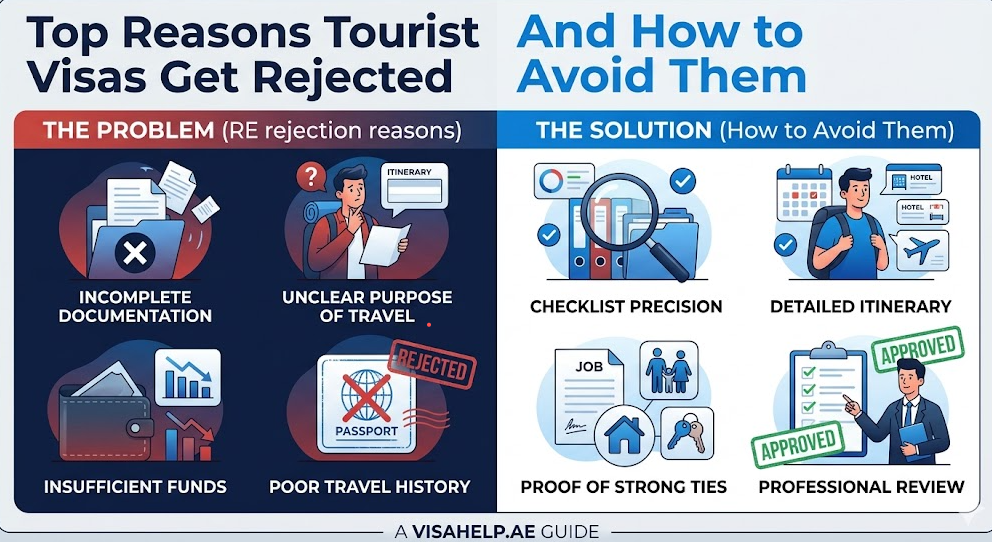
Here are the most common reasons tourist visas get rejected — and what you should do instead.
- Incomplete or Incorrect Documentation
This is the single most common reason for rejection — and the easiest to fix. Missing a single form, an unsigned page, or an outdated bank statement can result in a refusal, even if everything else is in order.
Common documentation mistakes include:
- Submitting expired documents (passport validity, bank statements older than 3 months)
- Missing supporting documents like travel insurance or hotel bookings
- Incorrect or inconsistent information across forms
- Unsigned or undated application forms
✅ VisaHelp Tip: Create a checklist for each country you’re applying to — requirements differ significantly between the UK, Schengen, USA, Canada, and Australia. VisaHelp provides destination-specific document guides to help you get it right the first time.
- Insufficient Financial Proof
Visa officers need to be confident that you can fund your trip without becoming a financial burden on the destination country. If your bank statements don’t clearly demonstrate this, your application is at risk.
What raises red flags:
- Low or inconsistent bank balance over the past 3–6 months
- Large unexplained deposits just before applying (lump sum deposits are a warning sign)
- No proof of stable income or employment
- Sponsorship letters without supporting financial documents from the sponsor
✅ VisaHelp Tip: Maintain a healthy, consistent balance in your account at least 3 months before applying. Sudden large transfers can appear suspicious. Always include salary slips, employer letters, or business proof alongside your bank statements.
- Weak Ties to Your Home Country
This is one of the most misunderstood rejection reasons. Embassies aren’t just checking if you can afford the trip — they want to be sure you’ll come back home after your visa expires.
Factors that suggest weak ties include:
- No stable employment or business in your home country
- No immediate family (spouse, children, parents) left behind
- No property ownership or long-term lease
- Recent job loss, resignation, or relocation
✅ VisaHelp Tip: Strengthen your application by including employment letters that confirm approved leave and a return date, property documents, family ties letters, or any other evidence that clearly shows your life is rooted at home.
- Purpose of Visit is Unclear or Unconvincing
If a visa officer can’t clearly understand why you’re travelling — or doesn’t find your reasons believable — your application will likely be rejected. A vague travel purpose is a red flag.
Mistakes to avoid:
- Listing ‘tourism’ without any supporting travel plan or itinerary
- No hotel bookings or confirmed accommodation
- Travel dates that don’t align with stated purpose
- Inconsistencies between your cover letter and your bookings
✅ VisaHelp Tip: Write a clear, specific cover letter that outlines your travel purpose, planned itinerary, and why you chose this destination. Include hotel confirmations, flight bookings, and a day-by-day itinerary where required.
- Previous Visa Violations or Travel History Issues
If you’ve overstayed a visa, been deported, or been refused entry in the past, this significantly impacts future applications. Embassies share data, and your travel history is visible.
Common issues include:
- Previous overstay in the same or a partner country
- Prior visa refusals that weren’t disclosed on the application
- Inconsistent or suspicious travel patterns
- Entry bans from other countries
✅ VisaHelp Tip: Always disclose prior refusals honestly — hiding them is grounds for automatic rejection (and potential bans). If you have a complicated travel history, a strong cover letter explaining the context can make a significant difference. VisaHelp can assist in drafting one.
- Travel Insurance Not Provided or Insufficient
For destinations like Schengen, travel insurance isn’t optional — it’s mandatory. But even for countries where it isn’t a hard requirement, missing insurance can weaken your application.
What to watch for:
- No travel insurance submitted with the application
- Insurance coverage that doesn’t cover the full duration of your trip
- Coverage amount below the required minimum (Schengen requires €30,000 minimum)
- Policy that doesn’t cover medical emergencies or repatriation
✅ VisaHelp Tip: Always buy travel insurance that covers the full duration of your trip and meets the destination’s minimum requirements. Keep a printed copy in your application and carry a digital copy during travel.
- Applying Too Late or at the Wrong Time
Timing matters more than most applicants realise. Applying too close to your departure date leaves no room for processing delays, additional document requests, or re-application in case of refusal.
Timing mistakes that lead to rejection or complications:
- Applying less than 2 weeks before departure for complex visa categories (UK, USA, Canada)
- Not accounting for public holidays in both your home country and the destination
- Applying outside the permitted application window (some countries only allow applications 3–6 months in advance)
✅ VisaHelp Tip: As a general rule: apply at least 4–8 weeks before your intended travel date. For the USA, Canada, and UK, longer processing times mean you should apply even earlier — sometimes 3 months in advance.
- Poor Application Presentation
Presentation matters. A disorganised application — with documents in the wrong order, poor translations, or missing labels — signals carelessness to a visa officer and makes their job harder. This can work against you.
Common presentation errors:
- Documents not in the required order
- Translations not certified or notarised where required
- Photos that don’t meet biometric specifications
- Handwritten forms that are difficult to read
✅ VisaHelp Tip: Organise your documents in the exact order specified by the embassy. Use professional translations for non-English documents. Ensure all photos meet biometric requirements. A well-presented application communicates professionalism and attention to detail.
Final Thoughts
A visa rejection doesn’t have to be the end of the road. In many cases, applicants are able to reapply successfully after addressing the specific reasons for refusal. The key is understanding exactly what went wrong — and building a stronger application the second time.
At VisaHelp, we review your complete profile before you apply, identify potential red flags, and help you put together an application that gives you the best possible chance of approval. Whether it’s your first application or a reapplication after a refusal, we’re here to guide you through every step.
Ready to apply with confidence?
Contact VisaHelp today and let our experts handle the details — so you can focus on planning your trip.